Characters: Atticus FinchBeside this, how does Atticus use ethos logos and pathos?
Pathos. Atticus uses ethos to prove Toms innocence by acknowledging the credibility of the courts: “Our courts have their faults, as does any human instiion, but in this country our courts are the tutgreat levelers, and in our courts all men are created equal" (205).
Additionally, how do authors establish ethos? You can establish ethos—or credibility—in two basic ways: you can use or build your own credibility on a topic, or you can use credible sources, which, in turn, builds your credibility as a writer. After all, think about the way advertisers use ethos to get us to purchase products.
Also Know, how does Atticus prove his own credibility to the jury?
Atticus uses ethos to prove Toms innocence by acknowledging the credibility of the courts: "Our courts have their faults, as does any human institution, but in this country our courts are the great levelers, and in our courts all men are created equal" (205). Atticus starts by building pity for Mayella Ewell.
What is an example of ethos?
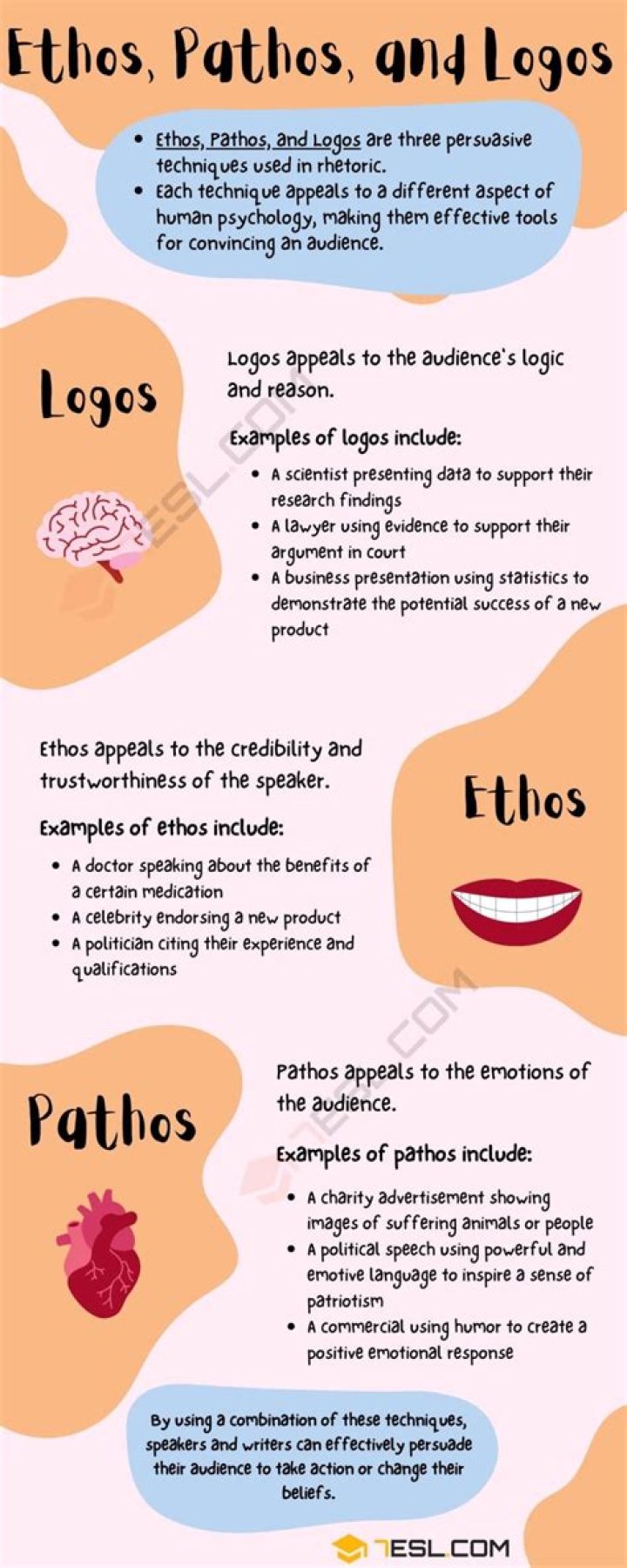
Ethos is when an argument is constructed based on the ethics or credibility of the person making the argument. Ethos is in contrast to pathos (appealing to emotions) and logos (appealing to logic or reason). Examples of Ethos: A commercial about a specific brand of toothpaste says that 4 out of 5 dentists use it.
What are ethos pathos and logos?
Ethos or the ethical appeal, means to convince an audience of the author's credibility or character. Pathos or the emotional appeal, means to persuade an audience by appealing to their emotions. Logos or the appeal to logic, means to convince an audience by use of logic or reason.What is Atticus's claim?
Atticus shocks the courtroom by claiming that Tom Robinson is not guilty, but someone else in the courtroom is. Atticus goes on to say that the case hinges on Mayella Ewell's feelings of guilt.Does Atticus pity mayella?
Atticus feels sorry for Mayella Ewell because she is just a lonely young girl caught in a situation that got out of her control. Atticus is aware that Mayella is not an evil person. He knows from talking to Tom Robinson that she lives a lonely life.What injustices does Atticus point?
Atticus explains how there is no medical evidence to convict Tom Robinson of raping and beating Mayella Ewell at the beginning of his closing remarks. He points out Mayella and Bob's conflicting testimonies and elaborates on why Mayella accused Tom Robinson of raping her.What rhetorical device did Atticus seem to use the most?
Atticus used two Rhetorical Devices anaphora and polysyndeton to get his point crossed. Atticus uses anaphora when he says "She is the victim of cruel poverty and ignorance." "she knew full well the enormity of her offense I cannot pitty her she is white".What is the tone of Atticus speech?
Atticus's Tone throughout his speech seems to be very calm, measured, and with many appeals to the audience's emotions. One of the first things he says in his speech is tell the jury that the State did not have “…What is the purpose of Atticus closing speech?
In Atticus's closing remarks, he condemns racial prejudice by denouncing the "evil assumption" that all black men are immoral individuals .What is a rhetorical device in literature?
A rhetorical device uses words in a certain way to convey meaning or to persuade. It can also be a technique used to evoke emotions within the reader or audience. Skilled writers use many different types of rhetorical devices in their work to achieve specific effects.What does Atticus tell the jury?
Atticus tells the jury that there is no place for racism in a courtroom, and they should treat Tom Robinson like any other defendant and acquit him. He then reminds the jury that there has been no proof that the crime took place, and there is proof that Mayella's father is the only guilty party.What famous quote did Atticus use in his closing speech?
“I have nothing to but pity in my heart for the chief witness for the state, but my pity does not extend so far as to her putting a man's life at stake, which she has done in an effort to get rid of her own guilt. “I say guilt, gentlemen, because it was guilt that motivated her.What does Atticus say to Tom Robinson?
"For a number of reasons," said Atticus. "The main one is, if I didn't I couldn't hold up my head in town, I couldn't represent this county in the legislature, I couldn't even tell you or Jem not to do something again."How does Atticus defend Tom?
Atticus defending Tom Robinson He feels he could never be proud of himself again or expect Jem and Scout to trust him again if he did not. He also knows that many lawyers in the county, if asked to take Tom's case, would not properly defend him as they would automatically assume he was guilty.What did Atticus say to Tom after the trial?
Atticus knew that it was very unlikely that Tom would win his trial. When Jem was bewildered at the verdict, Atticus replies: I don't know, but they did it. They've done it before and they did it tonight and they'll do it again and when they do it—seems that only children weep.How does Atticus end his summation?
Atticus ends his summation with the words, “In the name of God, believe him.” 5. Atticus removes his coat, unbuttons his vest and collar, and loosens his tie.What feeling do both Tom and Atticus have for mayella?
Both Atticus and Tom feel sorry for Mayella, but they also understand the reality of the position, which is that Mayella is the only one who can tell the truth and save Tom.What does Atticus do in court that the children never saw him do even at home?
Atticus proceeds to unbutton his vest and collar before loosening his tie and taking off his coat. Scout mentions that she had never seen her father loosen any article of clothing, except before bedtime, and says that his actions were equivalent to him standing stark naked in front of the entire courtroom.What phrase of the Constitution does Atticus refer to?
What Atticus is saying is that courts are supposed to treat all people equally. No matter how rich or influential one person is, that person is no different (before the law) than a poor person.